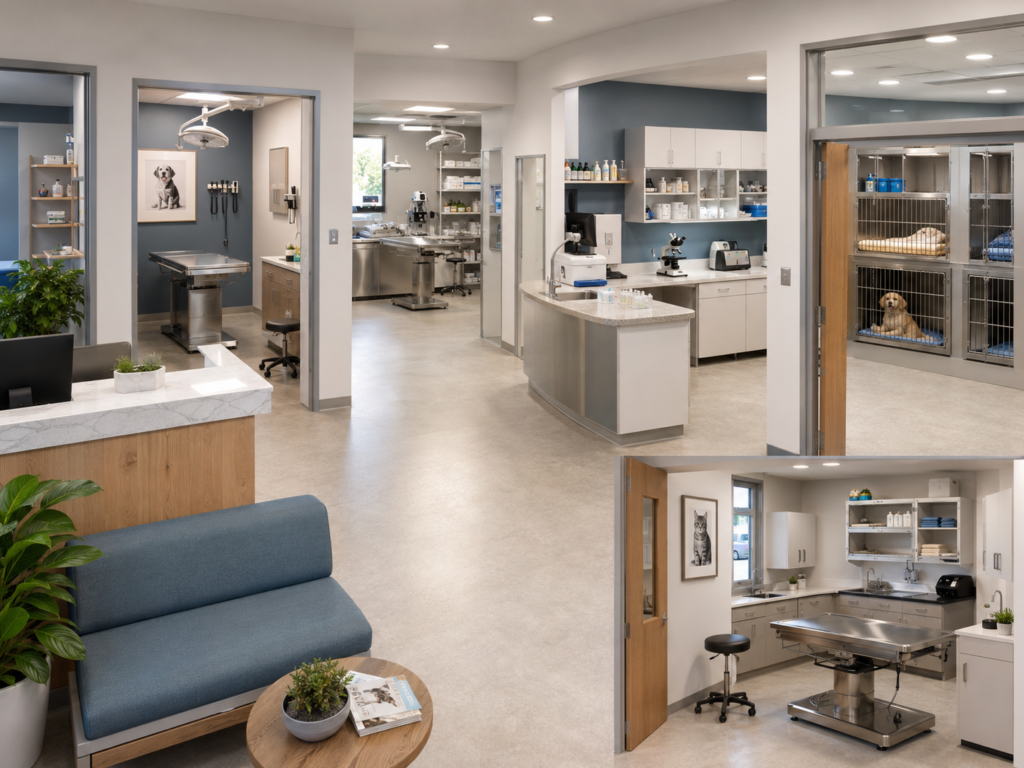
The examination room is one of the most frequently used spaces in a veterinary clinic. It should allow the veterinarian, assistant, pet owner, and animal to move safely while providing privacy and easy access to essential equipment.
Recommended Examination Room Size
A standard examination room may have a floor area of approximately:
- 7–9 m², or about 75–97 sq. ft., for a compact room
- 9–12 m², or about 97–129 sq. ft., for a more comfortable general-purpose room
- 12–15 m², or about 129–161 sq. ft., for large dogs, mobility assistance, or multi-person consultations
A practical internal dimension is approximately 2.7 × 3.3 meters or 3 × 3.6 meters.
Doorways should be wide enough for large dogs, carriers, wheelchairs, and mobile equipment. A clear opening of approximately 90 centimeters, or 36 inches, is often practical, subject to local accessibility requirements.
Recommended Room Structure
The room should contain:
- Examination table
- Digital animal scale
- Handwashing sink
- Base and wall cabinets
- Computer or tablet workstation
- Examination light
- Sharps container
- Medical waste bin
- General waste bin
- Paper-towel and soap dispensers
- Basic diagnostic equipment
- Storage for gloves and disposable supplies
The examination table should not block the entrance or restrict movement around the animal. At least three sides should remain accessible where possible.
A fold-down table may save space in compact rooms. A low platform or floor-level examination area is useful for large, elderly, or anxious dogs.
Flooring Materials
Recommended flooring should be:
- Non-slip
- Waterproof
- Seamless or installed with sealed joints
- Resistant to scratches and disinfectants
- Easy to clean
- Comfortable enough for staff who stand for long periods
Suitable options include commercial sheet vinyl, resin flooring, sealed rubber flooring, or high-quality safety flooring designed for healthcare environments.
Highly porous tiles, untreated wood, deep grout lines, and household carpet should be avoided.
Wall and Ceiling Materials
Walls should have a smooth, washable finish. Suitable options include:
- High-performance washable paint
- Fiberglass-reinforced wall panels
- Compact laminate protection panels
- Seamless hygienic wall coverings
Wall corners and lower wall sections may need additional protection from cages, carriers, moisture, and animal movement.
Ceilings should be smooth, moisture-resistant, and easy to maintain. Damaged or stained acoustic tiles should be replaced promptly.
Lighting and Ventilation
The room should combine comfortable general lighting with focused examination lighting.
A color temperature of approximately 3,500–5,000 Kelvin can provide clear visibility without making the space feel excessively cold.
Ventilation should control odors, moisture, airborne particles, and cleaning-product fumes. Air should not flow from an isolation room or infectious-patient area into general examination spaces.
Storage Organization
Frequently used items should be stored within easy reach. Cabinets should have smooth fronts and minimal open shelving because exposed supplies collect dust and are more difficult to disinfect.
Every examination room should follow the same storage layout. Standardization helps employees find equipment quickly and reduces mistakes.
Cat-Friendly Examination Rooms
A quieter room may be reserved for cats. Helpful features include:
- Raised space for carriers
- Non-slip table covering
- Warm examination surfaces
- Reduced noise
- Limited strong odors
- Minimal visual contact with dogs
- Places where cats can remain partially inside their carriers
Cleaning Requirements
Animal-contact surfaces should be cleaned and disinfected between patients. Door handles, keyboards, switches, chairs, scales, and other frequently touched surfaces must also be included in the cleaning schedule.