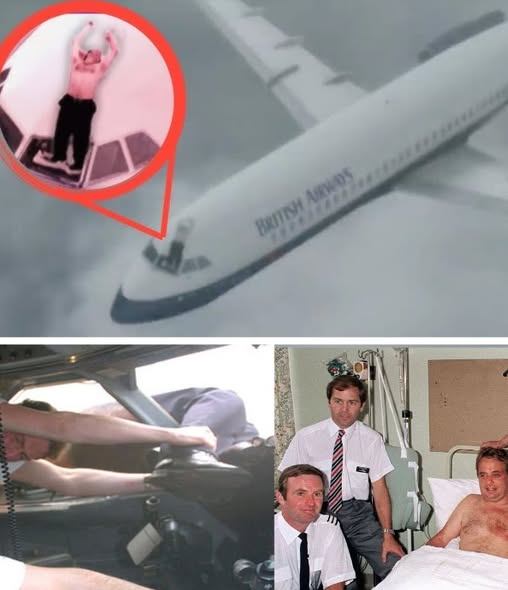
It was June 10, 1990, and a routine British Airways flight turned into one of the most extraordinary and dramatic aviation incidents in history.
British Airways Flight 5390, a BAC One-Eleven twin-jet, had taken off from Birmingham Airport with 81 passengers, heading for Malaga.
On board, Captain Tim Lancaster and First Officer Alastair Atchison were at the controls.
The Explosion in the Cockpit at High Altitude
After an uneventful takeoff, the aircraft had reached a cruising altitude of about $17,300$ feet (approximately $5,300$ meters).
While the cabin crew was preparing to serve breakfast, at 7:20 a.m., the cockpit was rocked by a violent blast.
The left-side windshield detached and shattered, causing an explosive decompression. The aerodynamic force immediately sucked Captain Tim Lancaster, who was sitting right next to the window, out of the cabin.
His body was flung outside, with his entire torso and head exposed, but his legs miraculously remained stuck inside the dashboard, held there by the force of the icy air pressing him against the fuselage.
The Fight Against the Wind and the Frost
The first to react was flight attendant Nigel Ogden.
He rushed into the cockpit and, seeing only Lancaster’s legs dangling precariously, secured himself to the captain’s seat with his own seatbelt and firmly grasped Lancaster’s legs, in a desperate move to prevent him from being completely sucked away.
Meanwhile, First Officer Atchison, though in shock and hindered by the deafening noise and icy wind blowing at approximately 800 km/h and temperatures of -17 °C, took control.
He put on his oxygen mask, engaged the autopilot, and immediately began an emergency descent. Unable to hear air traffic control due to the racket, he acted instinctively to save his colleague and the aircraft.
The strain soon became unbearable for Ogden, who began to suffer from the onset of frostbite and exhaustion. He was replaced by another crew member, flight attendant John Heward, who also secured Ogden to prevent him from being thrown out as well.
“All I could see were his legs,” Ogden later recounted, describing the 20 minutes of terror in which he held onto the captain. They fought against the force of the airstream, trying to tear Lancaster away, who, inert, had lost consciousness.
The Landing and the Investigation
At 7:55 a.m., thanks to Atchison’s skill and composure, the plane was authorized to land safely at Southampton Airport.
Lancaster was immediately rescued and taken to the hospital. Miraculously, he survived the incident, sustaining several bruises, fractures (a thumb, an arm, a wrist), frostbite, and shock.
Nigel Ogden also sustained injuries, including a dislocated shoulder and frostbite to his eye and face.
The investigation conducted by the Air Accident Investigation Branch (AAIB) revealed the cause of the incident: a major maintenance error.
Despite the human error, the crew’s professionalism and heroism saved the life of Captain Lancaster and everyone on board. Tim Lancaster returned to flying airplanes a few months later.
The astounding tale of British Airways Flight 5390 serves as a profound testament that even when human negligence creates a chasm of peril, the indomitable courage of individuals can bridge it.
It speaks to the incredible strength found in teamwork and the raw instinct to protect one another when all seems lost.
For Captain Lancaster, his miraculous survival against such overwhelming odds whispers of destiny—a life reclaimed from the very jaws of fate, demonstrating that sometimes, against all reason, some lives are simply meant to endure.