Introduction
Quiz-style puzzles like “Which one is not a vegetable?” are popular because they play on how people think in everyday life versus how things are defined in science. At first glance, the question seems simple—most of us recognize tomatoes, carrots, potatoes, and spinach as common vegetables.
However, the correct answer depends on an important detail: whether we are using everyday culinary language or botanical science. This difference is what makes the question both confusing and educational.
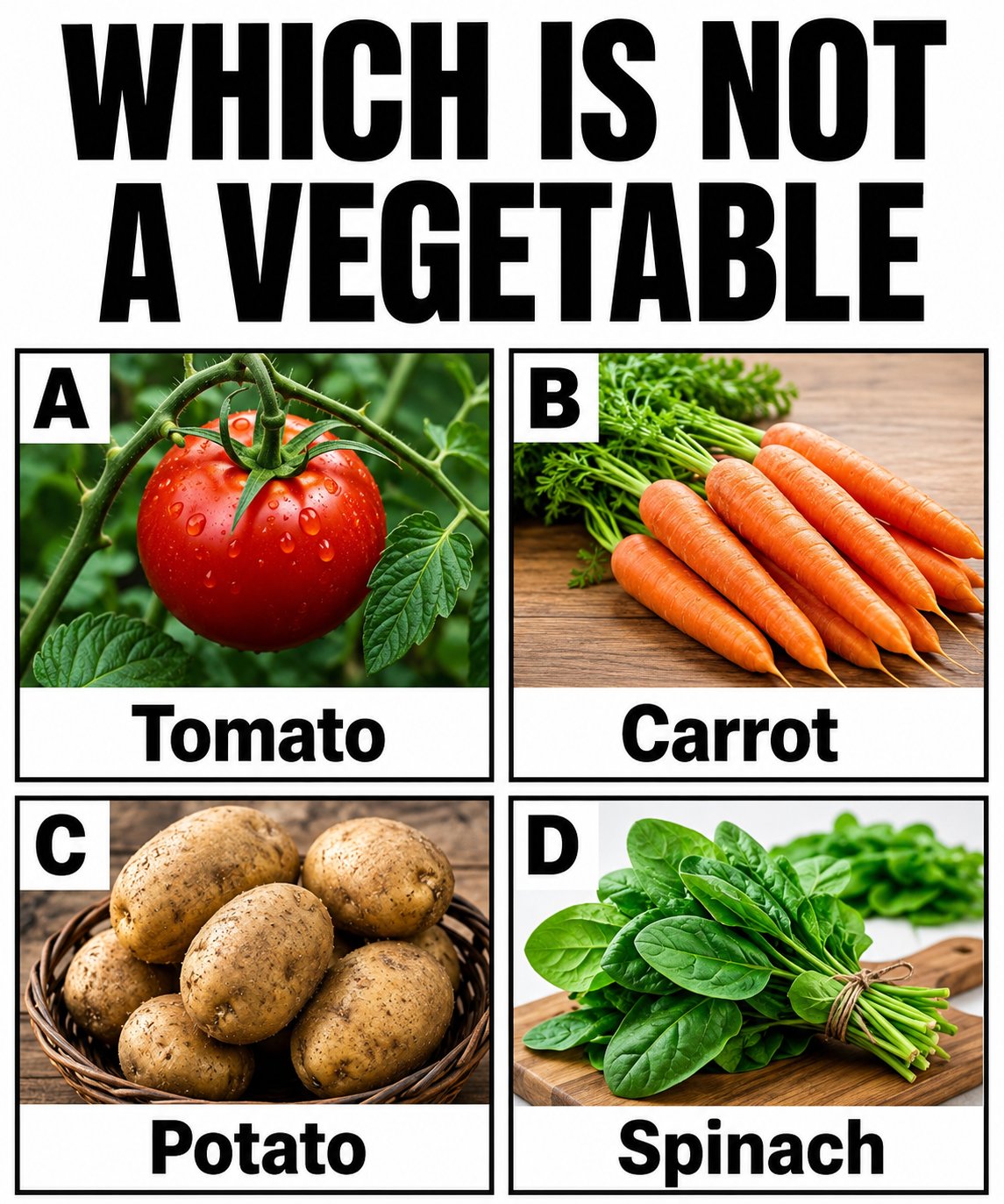
The Quiz Question
Take a look at the options:
A. Tomato
B. Carrot
C. Potato
D. Spinach
The question asks: Which one is not a vegetable?
At first, many people instinctively look for the “odd one out” based on how foods are used in cooking rather than how they are classified scientifically.
Why Tomato Confuses Most People
The most common answer people choose is the tomato. In everyday cooking, tomatoes are used in salads, sauces, soups, and savory dishes. Because of this, we naturally group them with vegetables in the kitchen.
But from a scientific point of view, tomatoes are classified differently. In botany, a fruit is the part of a plant that develops from a flower and contains seeds. By that definition, tomatoes are fruits because they grow from the flowering part of the plant and contain seeds inside.
This mismatch between culinary use and scientific classification is the main reason tomatoes often appear in trick questions like this.
Carrots: A True Root Vegetable
Carrots are much easier to classify correctly.
The part we eat is the taproot of the plant, which grows underground and stores nutrients. Because it is not a seed-bearing structure and does not develop from a flower, it is classified as a vegetable.
Nutritionally, carrots are well known for being rich in beta-carotene (which the body converts into vitamin A), fiber, and antioxidants. These nutrients support vision, immune health, and overall wellness.
In both culinary and botanical terms, carrots are firmly considered vegetables.
Potatoes: A Misunderstood Staple
Potatoes often cause confusion because they grow underground like roots. However, scientifically, potatoes are tubers, which are modified stems rather than roots.
Despite this distinction, potatoes are still classified as vegetables in cooking and general food categories because they are savory plant parts and not fruits.
They are also a major global staple food, providing carbohydrates and energy in diets around the world. Whether baked, boiled, mashed, or fried, potatoes remain one of the most widely consumed foods globally.
Spinach: The Leaf Category
Spinach is one of the simplest foods to classify correctly.
The edible part of spinach is the leaf of the plant. Leaves are considered vegetative (non-reproductive) parts of plants, which makes spinach a clear example of a vegetable.
Spinach is also widely valued for its nutritional content, including iron, vitamin K, folate, and antioxidants. It is commonly included in balanced diets and is associated with overall health benefits.
The Correct Answer
From a botanical perspective, the correct answer is:
✅ A. Tomato
Tomatoes are fruits because they develop from the flower of the plant and contain seeds. The other options—carrot, potato, and spinach—are all plant parts classified as vegetables in either culinary or botanical terms.
Why This Question Feels So Tricky
The confusion comes from two different ways of classifying food:
Culinary classification (kitchen use)
In everyday cooking:
Fruits are usually sweet or sour and eaten as desserts or snacks
Vegetables are usually savory and used in main dishes
By this logic, tomatoes are treated as vegetables.
Botanical classification (science-based)
In biology:
Fruits develop from flowers and contain seeds
Vegetables are other edible plant parts like roots, stems, and leaves
By this logic, tomatoes are fruits.
This difference is why many common foods don’t match people’s expectations when science is applied.
Bonus Challenge: More “Vegetables” That Are Actually Fruits
If tomatoes are fruits, then several other common foods also fall into the same category, including:
Cucumbers
Peppers
Pumpkins
Zucchini
Eggplants
All of these develop from flowering plants and contain seeds, making them fruits in botanical terms—even though they are used as vegetables in cooking.
Conclusion
This simple quiz highlights how language and science can describe the same thing in very different ways. In everyday life, we categorize food based on taste and cooking habits, while science focuses on structure and reproduction.
So while the answer to the puzzle is technically tomato, the real value of the question is not just the answer itself—it’s understanding why the answer changes depending on perspective.
That’s what makes these food classification quizzes both fun and surprisingly educational.se Tricky Questions
Take a close look at the image above and ask yourself a simple question:
Which one is not a vegetable?
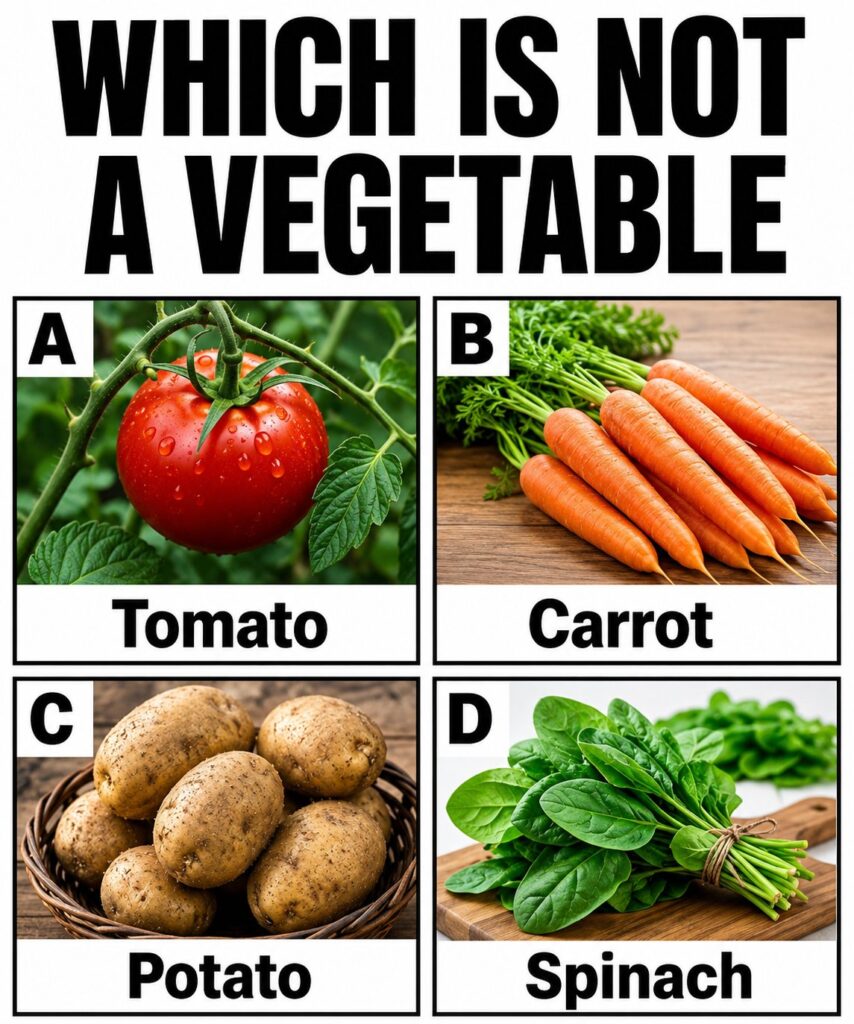
A. Tomato
B. Carrot
C. Potato
D. Spinach
At first glance, most people immediately focus on the tomato. After all, many of us have heard the famous statement that “a tomato is actually a fruit.” But is that really the correct answer?
The truth is a little more interesting than you might think.
Why Most People Choose Tomato
Tomatoes are commonly used in salads, sauces, soups, and countless savory dishes. Because they are rarely eaten as dessert, people naturally think of them as vegetables.
However, from a botanical perspective, a tomato develops from the flower of a plant and contains seeds. That makes it a fruit according to plant science.
This is why tomatoes often appear in quizzes and trick questions. They seem like vegetables in everyday life, but scientifically they belong to a different category.
What About Carrots?
Carrots 101: Facts, Benefits, Pro Tips & How to Grow It at Home – TrustBasket
Carrots are much more straightforward.
The orange part we eat is the root of the plant. Since it is an edible root rather than a fruit containing seeds, carrots are classified as vegetables.
Carrots are packed with beta-carotene, fiber, and vitamins, making them one of the most popular vegetables worldwide.
Are Potatoes Vegetables?
Many people are surprised to learn that potatoes are not roots like carrots.
Potatoes are actually underground stems known as tubers. Even so, they are still considered vegetables because they are edible plant parts that are not fruits.
Potatoes are rich in carbohydrates and serve as a staple food in many countries. Whether baked, mashed, or fried, they remain one of the most consumed vegetables on the planet.
What About Spinach?
Spinach is perhaps the easiest one to classify.
The part we eat is the leaf of the plant. Since leaves are vegetative plant structures, spinach is unquestionably a vegetable.
It is also famous for being rich in iron, vitamins, and antioxidants, making it a favorite among health-conscious eaters.
So What Is the Correct Answer?
If we’re using botanical science, the correct answer is:
✅ A. Tomato
Tomatoes are fruits because they grow from flowers and contain seeds.
Carrots, potatoes, and spinach are all vegetables because they are roots, tubers, or leaves rather than fruits.
Why This Question Confuses So Many People
The confusion comes from the difference between culinary definitions and scientific definitions.
In the kitchen, foods are often categorized based on how they taste and how they are used in recipes.
Sweet foods are usually called fruits.
Savory foods are often called vegetables.
By that standard, tomatoes are commonly treated as vegetables.
In science, however, classification is based on plant structure and reproduction. Since tomatoes contain seeds and develop from flowers, they are fruits regardless of how they taste.
Final Challenge
Now that you know the answer, here’s another question:
If tomatoes are fruits, what about cucumbers, pumpkins, peppers, zucchini, and eggplants?
Believe it or not, all of them are fruits from a botanical perspective as well.
That simple quiz image proves an interesting lesson: sometimes the answers we use every day are different from the answers science gives us. And that’s exactly what makes questions like this so fun.