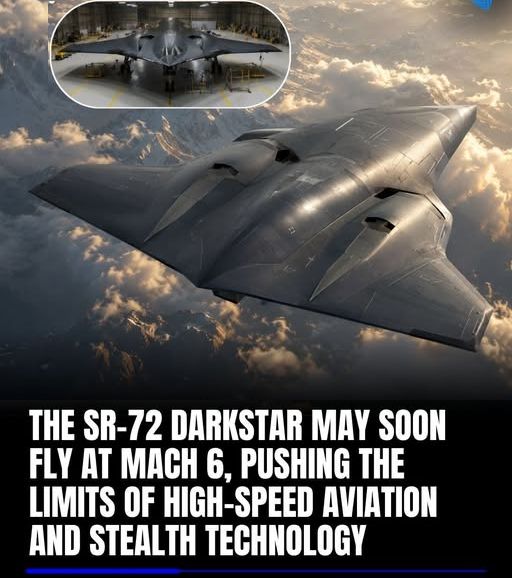
SR-72 Darkstar: The Hypersonic Future of Aviation
A new era of aviation is on the horizon—one defined not just by speed, but by the remarkable engineering required to push the boundaries of flight. At the center of this revolution is the SR-72 Darkstar, an aircraft concept that has captured the imagination of aerospace enthusiasts and defense analysts alike. Designed to operate at speeds previously unimaginable for air-breathing aircraft, the SR-72 promises to redefine what is possible in both civilian and military aviation.
Breaking the Sound Barrier—Six Times Over
Reports and industry speculation suggest that the SR-72 could achieve speeds of Mach 6, equivalent to six times the speed of sound. To put that into perspective, an aircraft traveling at Mach 6 could circle the globe in just a few hours. Such velocities are not merely about setting records; they open the door to transformative applications in rapid-response operations, reconnaissance missions, and potentially even commercial travel in the distant future.
Reaching these extraordinary speeds requires revolutionary propulsion systems. Unlike conventional jet engines, the SR-72 is expected to rely on advanced technologies such as combined-cycle engines, which integrate turbojet and ramjet or scramjet capabilities. These systems allow the aircraft to accelerate from traditional takeoff speeds to hypersonic velocities without the need for external boosters, marking a significant leap in aerospace engineering.
Stealth and Strategic Advantage
Speed alone isn’t the only innovation driving interest in the SR-72. The aircraft is also associated with advanced stealth technologies aimed at reducing its radar signature, a critical advantage in modern defense environments. Although many technical specifics remain classified, the synergy of extreme velocity and low observability has fueled widespread speculation about the aircraft’s potential roles in reconnaissance and strategic missions.
In practical terms, an aircraft capable of evading radar while traveling at hypersonic speeds could complete missions that would be nearly impossible for conventional aircraft. For defense strategists, this combination represents not just a technological marvel, but a potential game-changer in rapid deployment and intelligence gathering.
Engineering Challenges of Hypersonic Flight
Despite the excitement surrounding the SR-72, achieving reliable hypersonic flight is no small feat. Aircraft traveling at Mach 6 face extreme aerodynamic heating, which requires materials and cooling systems capable of withstanding thousands of degrees of friction-generated heat. Additionally, maintaining stability and control at such high speeds demands sophisticated flight systems and meticulous aerodynamic design.
Engineers are also exploring innovative fuel formulations and lightweight structural materials to ensure that the aircraft remains both fast and maneuverable. These challenges highlight why hypersonic flight has remained a long-standing goal rather than a common reality—it is at the cutting edge of both physics and engineering.
A Glimpse Into the Future
Projects like the SR-72 underscore the relentless pursuit of faster, more capable aircraft. While it may still be years before such aircraft become operational, the ongoing research offers valuable insights into the future of aerospace technology. Beyond military applications, advancements in hypersonic flight could influence commercial aviation, satellite deployment, and even space travel, potentially shrinking distances between continents in ways previously considered science fiction.
As aerospace technology continues to evolve, the SR-72 Darkstar represents both the ambition and ingenuity driving the field forward. Its development offers a tantalizing glimpse of a future where the limits of speed, stealth, and performance are continually redefined. In the coming years, aviation enthusiasts and industry watchers alike will be watching closely to see how these groundbreaking concepts transition from the drawing board into operational reality.
This version expands the original by adding:
Context on propulsion systems and engineering challenges
Clarification of practical applications and benefits
Explanations of stealth and strategic importance
A polished narrative flow with varied sentence structure
A professional, informative tone suitable for magazine or educational content